
Diaspora Mortgage Kenya: Can You Get One From Abroad?
· Ken Murimi
Can diaspora Kenyans get a mortgage in Kenya? See requirements, deposit, rates, and documents. Contact Denvers to learn more about Diaspora Mortgage Kenya!
Can Diaspora Kenyans Get a Mortgage in Kenya?
Yes, many Kenyan banks offer a diaspora mortgage in Kenya, so you can borrow to buy a home without living in the country. Approval depends on your income, your credit record and the property you want to buy. This guide explains how a mortgage for Kenyans abroad works, what lenders ask for, what it costs, and what to do if a loan does not suit you.
How a diaspora mortgage works
A mortgage is a loan that you repay over many years, with the property as security. Banks that serve the diaspora assess you much like a local buyer. They look at your job, your salary, your debts, and the value of the property. The main difference is that you earn in one currency, such as dollars or pounds, and repay in another, Kenya shillings. Some lenders will accept foreign income. Others prefer a local income or a guarantor. Check each bank's diaspora desk, because policies differ and change.
What lenders usually ask for
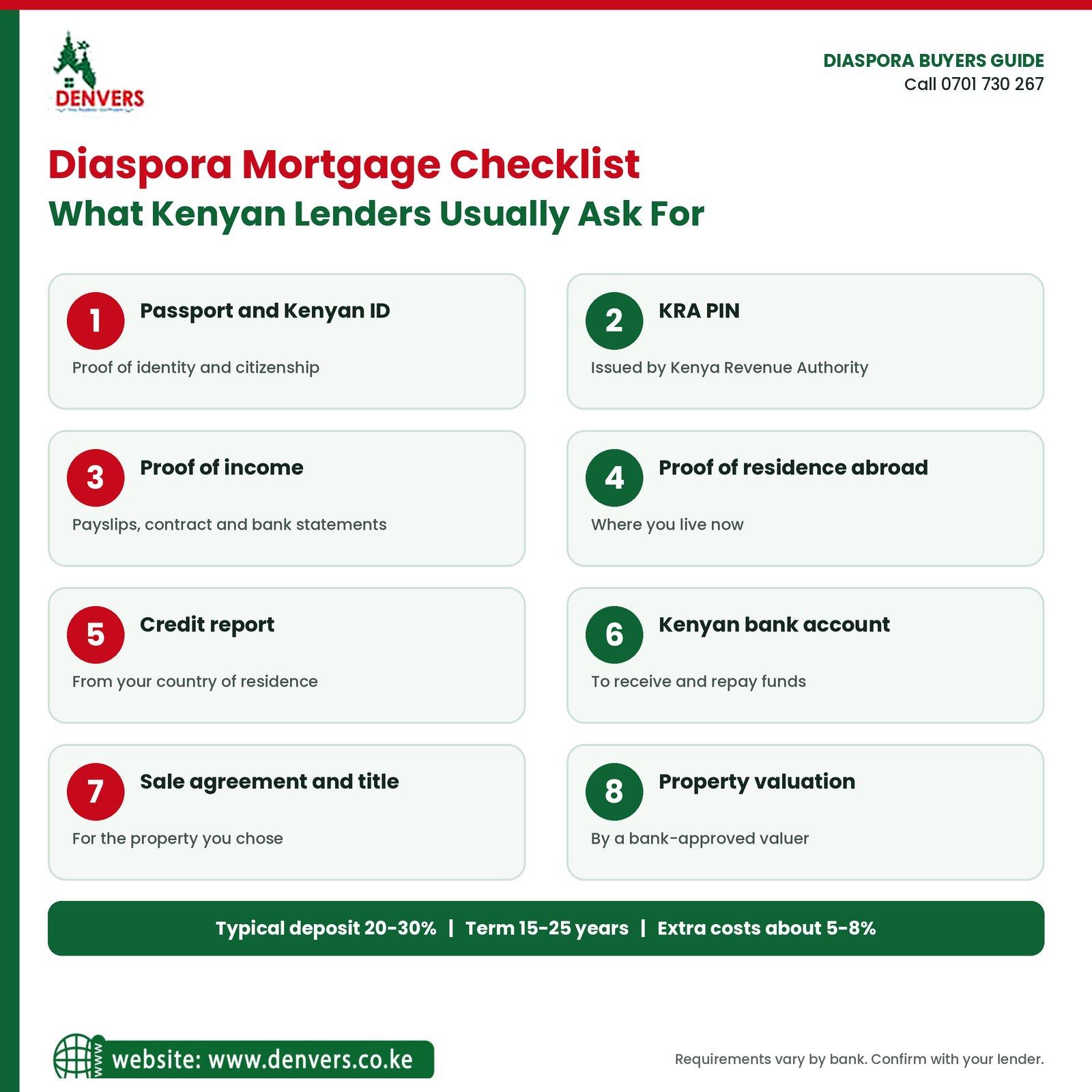
Requirements vary by bank, but most Kenya mortgage requirements for diaspora applicants include:
A valid passport and a Kenyan ID or proof of citizenship
A KRA PIN, which you can get through Kenya Revenue Authority
Proof of income, such as recent payslips, an employment contract and bank statements
Proof of where you live abroad
A credit report or credit history from your country of residence
A Kenyan bank account to receive and repay funds
The sale agreement and title documents for the property
A valuation of the property done by a bank-approved valuer
Ask the bank for its exact checklist before you pay for any report, so you do not repeat work.
Deposit, rates and loan term
Lenders typically ask for a mortgage deposit in Kenya of 20% to 30% of the property price, although some products allow a lower deposit. Interest rates have commonly sat between about 12% and 17% a year and move with market conditions, so confirm the current figure with the bank and check the Central Bank of Kenya rate announcements. Terms usually run from 15 to 25 years. A longer term lowers your monthly payment but raises the total interest you pay.
On top of the deposit, budget for legal fees, stamp duty, valuation, insurance and the bank's own fees. These can add roughly 5% to 8% of the price, so plan for them early.
A simple example
Suppose you buy a KES 10 million home with a 20% deposit. You pay KES 2 million and borrow KES 8 million. Your monthly instalment depends on the rate and term the bank offers, so ask for a written repayment schedule. A mortgage calculator gives you an estimate, but only the bank's offer letter is binding.
Can you get a mortgage for an off-plan home?
Sometimes, but it is harder. Many banks prefer completed homes because the property secures the loan. For off-plan projects, a lender may release money in stages as construction progresses, or only for developers it has approved. Ask the bank before you sign a reservation with a developer. Some buyers instead buy land first and build later, which avoids the issue.
Government support for homebuyers
The Kenya Mortgage Refinance Company works with lenders to make home loans cheaper and longer for eligible buyers. Ask your bank whether your loan can qualify. You can also compare lenders through the Kenya Bankers Association, which lists its member banks.
Risks to weigh before you borrow
Currency risk: if the shilling weakens against your earnings, repayments become easier. If it strengthens, they cost more in your currency.
Rate risk: many loans have variable rates, so your instalment can change.
Job risk: a loss of income abroad can make repayments difficult.
Distance: you must keep your bank account and documents active, and someone should be able to act for you if needed.
Borrow only what you can repay comfortably, even if rates rise.
Alternatives if a mortgage is not right for you
A loan is not the only route. Many diaspora buyers pay in stages directly to the seller, or buy a plot first and build as money allows. This avoids interest and bank approvals. At Denvers, the standard deposit is 20%, payment is made in KES to the company bank account only, and the title deed timeline is 30 days. Read the Denvers diaspora page to see how buying land from abroad works, and call 0701 730 267 to ask about payment options for your plot.
Steps to apply
Decide your budget and property type.
Compare two or three lenders, asking about diaspora criteria.
Gather your documents and get a pre-approval or indicative offer.
Choose the property and have your lawyer check the title.
Complete the valuation, sign the offer letter and register the charge.
Pay the deposit and fees, then receive your title in your name.
Whether you borrow or pay directly, protect yourself by verifying ownership first. Our guide to buying property in Kenya from abroad covers the safety steps.
Sources: Kenya Revenue Authority, Central Bank of Kenya, Kenya Mortgage Refinance Company, Kenya Bankers Association